
Caregiver Guilt and Burnout: Why Positive Thinking Alone Isn’t Enough
Do daily affirmations actually help stressed family caregivers, or do they just add more pressure?
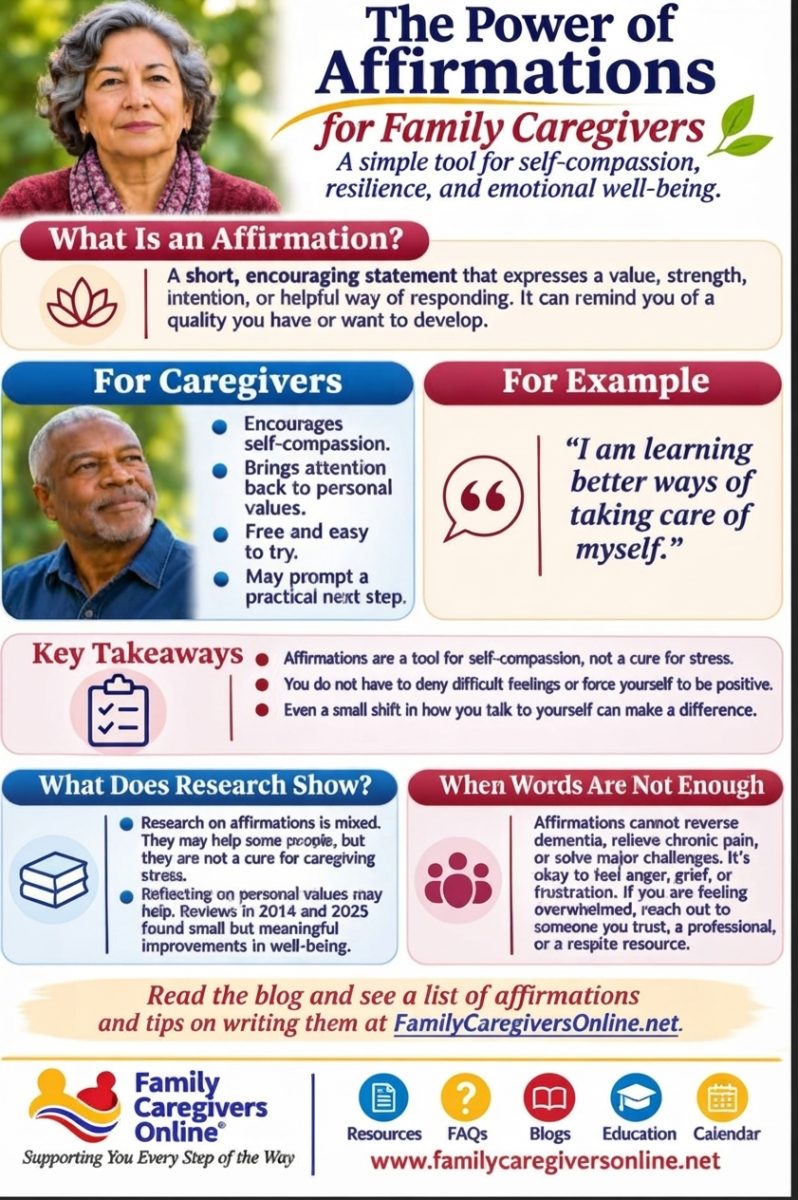
Repeating overly upbeat phrases won’t erase the exhaustion of caring for someone with dementia or chronic illness—and can sometimes make you feel worse if those words feel fake. However, pairing mindfulness (honestly acknowledging how hard today is) with values-based affirmations (reminding yourself of your patience, intention, and effort) gives you a free, practical way to ease self-criticism and reset during stressful moments.
Why Caregiver Self-Talk Backfires—and How to Make Affirmations Work
When you are managing medications, navigating memory loss, or handling the physical demands of supporting the person in your care, your inner voice can quickly turn harsh. It is completely normal to catch yourself thinking, “I’m not doing enough,” “I should have been more patient,” or “How much longer can I keep doing this?”
Many caregivers try to push those thoughts away with forced optimism, only to end up feeling more frustrated. Here is why standard affirmations often fall flat:
- Unrealistic statements create inner friction: Research by Wood and colleagues (2009) found that repeating overly positive statements can actually make people feel worse when those words clash with their reality. Telling yourself “Everything is easy and wonderful” when you are running on four hours of sleep feels hollow.
- Words cannot replace real-world support: Affirmations cannot reverse dementia, relieve chronic pain, resolve financial strain, or give you an afternoon off. When you treat positive thinking as a cure-all, it becomes just one more chore on an already impossible to-do list.
- You are holding yourself to an unfair standard: You likely offer the person in your care endless patience and grace, while judging yourself harshly for feeling tired, sad, or frustrated.
Pair Mindfulness with Grounded, Values-Based Affirmations
Research shows that how you use an affirmation matters far more than any magic phrasing. A major review by Cohen and Sherman (2014) and a 2025 meta-analysis of 67 studies found that reflecting on your core personal values—rather than just chanting upbeat slogans—creates meaningful improvements in emotional well-being.
Instead of forcing yourself to feel cheerful, use these three steps to make affirmations genuinely supportive:
- Combine Mindfulness with Self-Compassion Mindfulness simply means noticing what is happening right now—your stress, your surroundings, the feel of the sun or a deep breath—without judging yourself for how you feel. When you pair mindfulness with a grounded affirmation, you validate your reality while choosing a kind next step:
- Mindfulness: “I am feeling completely overwhelmed right now.”
- Affirmation: “I can take this one step at a time.”
- Combined: “Although I am feeling overwhelmed right now, I can take this one step at a time.”
- Choose Words That Feel True to You There is no rule that says you must start every phrase with “I am.” If “I am calm” feels impossible, shift to phrases that reflect your effort and values, such as “I value…”, “I choose…”, or “I am learning…”
- Instead of “I never do anything right,” try: “I am learning as I go, and I am doing the best I can for the person in my care.”
- When you feel stretched thin, try: “I don’t have to do everything today; I only need to handle the next right thing.”
- Know When Words Are Not Enough Anger, grief, sadness, and exhaustion are honest responses to hard circumstances—you do not owe anyone a constant smile. When an affirmation isn’t enough, let your self-talk guide you toward real action: “Today is heavy, and I need support.” Use that moment as a prompt to call a trusted friend, reach out to a healthcare professional, join a caregiver support group, or look into local respite care.
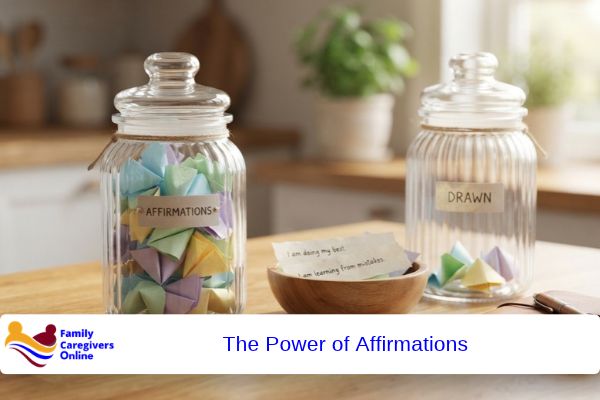
My Affirmation Jars
If you want an easy, low-pressure way to try this, keep it visual. I printed a list of grounded affirmations, cut them into strips, folded them like fortune cookies, and placed them in one of two decorative jars I already had at home. Each day, I pull out one slip, read it, and move it into the second jar. Once the first jar is empty, I switch and start again. You can download our printable list of affirmations at familycaregiversonline.net, or write a few of your own that speak directly to your journey.
Research Sources
- Cohen, G. L., & Sherman, D. K. (2014). The psychology of change: Self-affirmation and social psychological intervention. Annual Review of Psychology, 65, 333–371. https://doi.org/10.1146/annurev-psych-010213-115137
- Flynn, M. K., & Bordieri, M. J. (2020). On the failure to replicate past findings regarding positive affirmations and self-esteem. Journal of Contextual Behavioral Science, 16, 49–61. https://doi.org/10.1016/j.jcbs.2020.03.003
- Wood, J. V., Perunovic, W. Q. E., & Lee, J. W. (2009). Positive self-statements: Power for some, peril for others. Psychological Science, 20(7), 860–866. https://doi.org/10.1111/j.1467-9280.2009.02370.x
- Zhang, Y., Chen, B., Hu, X., & Wang, M. (2025). The impact of self-affirmation interventions on well-being: A meta-analysis. American Psychologist. https://doi.org/10.1037/amp0001591
We hope this information is helpful to you in the important work you do as a family caregiver.
For more resources, subscribe to our free newsletter!



