
How do I travel through an airport with someone who has an invisible disability?
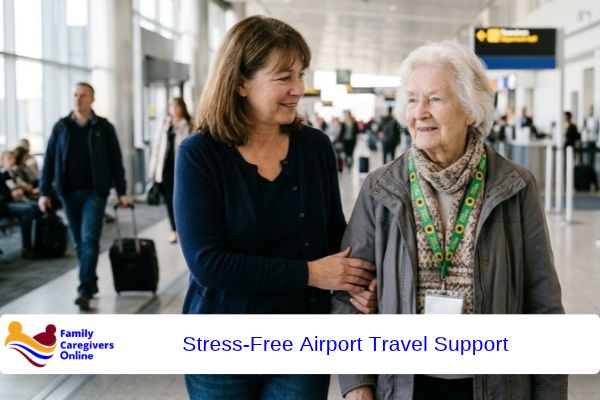
The Hidden Disabilities Sunflower program lets the person in your care wear a simple green sunflower lanyard to discreetly signal to trained airport and airline staff that they may need extra time, patience, or assistance. Over 350 airports across 70 countries and 31 major airlines participate—including United, British Airways, Air Canada, and Emirates—offering free lanyards at participating airport accessibility or information desks.
The Quiet Weight of Traveling Together
Take a deep breath. If the mere thought of navigating an airport security line with the person in your care makes your chest tighten, you are not alone.
Packing bags is the easy part. The hard part is the invisible mental load you carry from the moment you step out of the car at the terminal. You are scanning the crowd for sensory triggers. You are watching for signs of fatigue, confusion, or overwhelm. And when the person in your care doesn’t use a wheelchair or have an obvious physical marker, you carry an extra layer of stress: the fear of judgment.
You worry about the impatient sigh behind you at TSA. You dread having to publicly explain a dementia diagnosis, hearing loss, anxiety, or chronic pain to a rushed gate agent while the person in your care stands right beside you.
What you are feeling is completely normal. You are trying to protect their dignity while keeping everything moving forward. It is exhausting.
Why Airports Feel So Overwhelming
Airports are built for speed, not processing time. Bright fluorescent lights, echoing announcements, crowded concourses, and strict security protocols create a sensory storm.
When a condition isn’t visible—whether it is early-stage memory loss, autism, PTSD, a heart condition, or low vision—staff and fellow travelers naturally assume everyone can move at the exact same pace. Without a visual cue, you are forced into a constant cycle of advocating, explaining, and apologizing just to buy a few extra seconds of grace.
A Simple Signal That Speaks for You
Launched at London Gatwick Airport in 2016, the Hidden Disabilities Sunflower program was created to take that explaining off your plate.
The concept is remarkably simple. By wearing a green lanyard or pin patterned with bright yellow sunflowers, the person in your care discreetly signals to staff that they have a non-apparent disability and might need a helping hand, clearer communication, or just a little more time.
Here is what the program looks like on the ground:
- Global Reach: More than 350 airports across 70 countries—including major U.S. hubs like Atlanta, Chicago O’Hare, Dallas/Fort Worth, Denver, JFK, Miami, and Nashville—actively recognize the Sunflower.
- Airline Support: Thirty-one airlines, such as United Airlines, Air Canada, British Airways, Lufthansa, and Qantas, have trained their workforces to recognize the lanyard from check-in to arrival.
- Zero Disclosure Required: You do not have to prove a diagnosis or explain private medical details to wear the Sunflower. The lanyard does the talking.
- No Cost at Participating Hubs: You can pick up a complimentary Sunflower lanyard at the information or accessibility desk at participating airports, or order personalized ID cards online ahead of your trip.
Setting Realistic Expectations
It helps to know exactly what the Sunflower does—and what it doesn’t do—before you arrive at the terminal.
Wearing the lanyard does not provide fast-track security clearance or automatic priority boarding. If the person in your care needs wheelchair transport or formal escort assistance through security, you should still book those services directly with your airline and contact TSA Cares at least 72 hours before your flight.
What the Sunflower does give you is an immediate shift in human interaction. Trained staff know to slow down, speak clearly, offer step-by-step guidance at security checkpoints, and give the person in your care the space they need without rushing them.
Your Next Steps for a Smoother Trip
You don’t have to white-knuckle your way through your next flight. Before you travel:
- Check Your Route: Visit the Hidden Disabilities Sunflower airport directory (hdsunflower.com) to confirm your departure and arrival airports participate.
- Pick Up Your Lanyard Early: Check your departure airport’s accessibility webpage to see where their free Sunflower lanyards are kept, or order a kit ahead of time so the person in your care can get used to wearing it.
- Pair It With Airline Support: Notify your airline of any specific mobility or cognitive needs when booking so your Sunflower lanyard works alongside formal accommodations.
Travel doesn’t have to be off-limits just because the road looks different now. With a simple green lanyard, you can walk into the terminal knowing there is a quiet network of support waiting to meet you both with patience.
For more information click here
We hope this information is helpful to you in the important work you do as a family caregiver.
For more resources, subscribe to our free newsletter!



