

Holiday scams hit caregivers hard.
The holidays are busy, emotional and full of deadlines. Scammers know it, and they plan for it. Family caregivers are often targeted twice: once as a person managing money and mail for someone else, and again through the older adult they care for.
The good news is that most holiday scams follow the same playbook. Once you know it, a few simple habits can shut them down. Use the checklist below, and share it with the people you care for.
1. Set up now, before a scammer calls
A little preparation makes you much harder to fool in the moment.
- Pick a family safe word. Share it with everyone, including grandchildren. If someone calls in a panic claiming to be family, ask for the word.
- Save real numbers in your phone. Keep family, your doctor and your bank where you can find them fast.
- Turn on alerts. Set up text or email alerts for every bank and card purchase.
- Check your credit. You can get your credit reports free at annualcreditreport.com, and you can ask about a free credit freeze.
- Let unknown calls go to voicemail. Real callers leave a message.
2. When anyone asks for money or information
Scammers want you rushed and scared. Slow the conversation down with three words: Pause. Verify. Tell someone.
- Pause. Hang up or stop replying. Nothing real disappears in ten minutes.
- Verify. Call back using a number you already know, never one from the call, text or email.
- Tell someone. Call a family member or friend before you do anything.
A few more rules worth keeping handy:
- Never click links in unexpected texts or emails, even for a package or a prize.
- Never pay with gift cards, wire transfers, crypto, payment apps or cash to someone who contacted you.
- “Don’t tell anyone” is a red flag. Real agencies and real family do not ask for secrecy.
- Medicare, Social Security and your bank will not call to demand payment or your account numbers.
- Look up a charity yourself before giving. Do not use the phone number or link they gave you.
3. If it already happened
It happens to smart, careful people every day. Act quickly and do not be embarrassed.
- Stop all contact. Do not send more money.
- Call your bank or card company right away and ask to stop or reverse the payment.
- Change passwords on any account you shared, and turn on two-step verification.
- Write it down. Note who, when, how much and how you paid. Keep screenshots and receipts.
- Report it. Reporting helps protect others.
Dec 15th webinar (Free via Zoom)
Want more? Be sure to check out the free webinar on December 15 at 1:00 pm, “Sneaky Holiday Scams Targeting Caregivers and Seniors,” presented by Paula Hill and hosted by the WellMed Charitable Foundation Caregiver Teleconnection. You will see real examples of today’s scams, learn simple ways to protect your money, and get your questions answered. Register here
Where to report and get help
- Federal Trade Commission: ReportFraud.ftc.gov
- FBI Internet Crime Complaint Center: ic3.gov
- National Elder Fraud Hotline: 833-372-8311
- AARP Fraud Watch Helpline: 877-908-3360
- Medicare: 1-800-MEDICARE (1-800-633-4227)
- Senior Medicare Patrol (Medicare fraud): 877-808-2468
- Texas Adult Protective Services: 1-800-252-5400
- Forward scam texts to your carrier: text 7726 (SPAM)
Download this printable checklist: Holiday Scam Defense Checklist (PDF)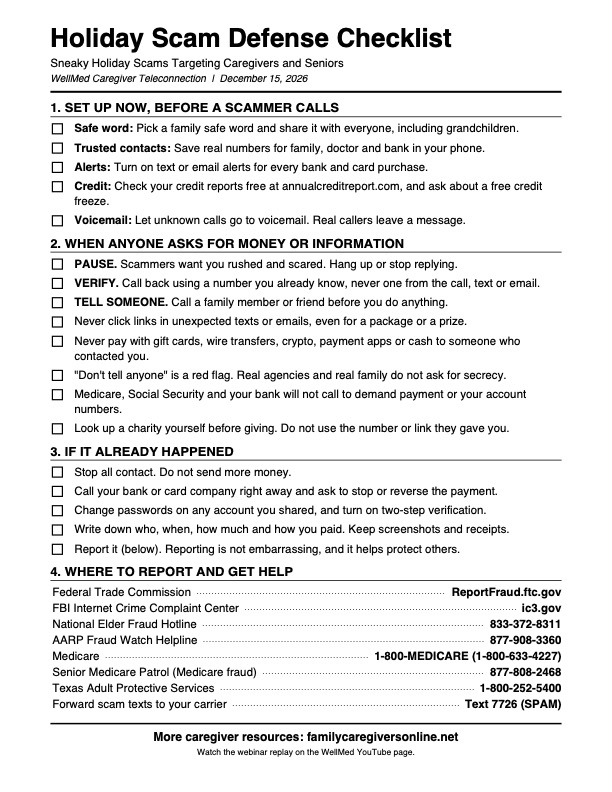
By Paula Hill, Family Caregiver & Staff Writer for Family Caregivers Online
We hope this information is helpful to you in the important work you do as a family caregiver.
For more resources, subscribe to our free newsletter!



