

Simple Ways to Help a Care Receiver Feel Safe, Respected, and Involved
Trust is an essential part of caregiving.
For a care receiver, trust can mean: “I feel safe with you. You will listen to me. You will treat me with respect.”
Trust grows when a caregiver is dependable, honest, patient, and respectful. It also grows when the care receiver is included in choices and decisions whenever possible.
Trust does not mean that the caregiver and care receiver will always agree. It means the person receiving care believes the caregiver is trying to help, will respect their dignity, and will involve them in their own care as much as possible.
For the caregiver, trust also means being able to work together and communicate about needs, concerns, pain, preferences, and changes in health as much as the care receiver is able.
At a Glance: Ways to Build Trust – Trust is strengthened by everyday actions:
- Explain before helping.
- Listen
- Offer choices.
- Respect privacy.
- Keep promises.
- Stay calm.
- Encourage independence whenever safely possible.
1. Explain Before You Help
One of the simplest ways to build trust is to tell the person what you are going to do before you do it.
Being touched, moved, dressed, bathed, or helped without warning can be uncomfortable or frightening, especially when a person is already dealing with illness, pain, weakness, or loss of independence. This is especially true for a care receiver with dementia.
Try this simple approach:
Get their attention ? Explain ? Give them time to respond ? Help
For example: “John, I’m going to help you stand now. Are you ready?”
Or: “I’m going to move your pillow a little so you are more comfortable.”
A few extra seconds can make care feel more respectful and less like something is simply being done to the person.
2. Listen Before Trying to Fix the Problem
Fear is frequently why care receivers resist help or change. A care receiver may feel angry, embarrassed, sad, frustrated, or tired.
You do not always need to make those feelings go away.
Sometimes trust grows simply because the caregiver listens and takes the person’s feelings seriously.
Instead of saying: “Look on the bright side.”
you might say: “I know this is frustrating.”
or: “I can understand why you feel that way,” not “I know how you feel,” because you really don’t know until you are living his life.
Listen for what may be underneath the words. Refusing help, becoming quiet, turning away, or becoming irritated may mean the person is confused, uncomfortable, embarrassed, tired, or simply needs more time.
3. Offer Choices
Needing help should not mean losing every choice.
Look for small ways the care receiver can remain involved in everyday decisions.
For example:
“Would you like the blue shirt or the gray one?”
“Would you like breakfast now or in 15 minutes?”
“Would you like the curtains open or closed?”
One or two choices are usually enough. Too many options can become overwhelming.
Small choices can help a person maintain a sense of control over their own life.
4. Encourage Independence
Caregiving often requires a difficult balance between helping and taking over.
If the person can safely do part of a task, give them the opportunity and enough time to do it.
They may be able to wash their face, choose their clothing, feed themselves, brush their hair, fold towels, or participate in another part of their daily routine.
It may take longer.
That does not mean you should automatically do it for them.
Maintaining skills and participating in everyday tasks can support confidence, dignity, and independence.
5. Protect Privacy and Dignity
Personal care can make anyone feel vulnerable.
During bathing, dressing, toileting, or other personal care:
- Keep the person covered as much as possible.
- Ask permission before helping.
- Knock before entering a closed room.
- Ask before opening drawers, purses, closets, or personal belongings.
- Be thoughtful about who receives private medical or personal information.
- A person who needs assistance is still an adult with personal boundaries, preferences, belongings, and a right to privacy.
6. Keep Promises – and Explain When Plans Change
Reliability helps build trust.
If you say you will come back after lunch, make a phone call, help with a task, or take care of something important, try to follow through.
Of course, caregivers cannot control everything.
Plans change. Emergencies happen. People forget.
When that happens, explain what changed rather than pretending the promise was never made.
Trust does not require perfection. It does require honesty.
7. Stay Calm
Caregiving can be frustrating for both people.
A calm tone of voice, slower pace, and simple explanation can help keep a difficult moment from becoming more stressful.
Staying calm does not mean ignoring your own feelings or tolerating unsafe behavior. It means trying not to add more fear, anger, or confusion to an already difficult situation.
If possible, stop and try again later when either person is becoming overwhelmed.
These actions may seem small, but repeated respectful experiences can help a care receiver know what to expect from you.
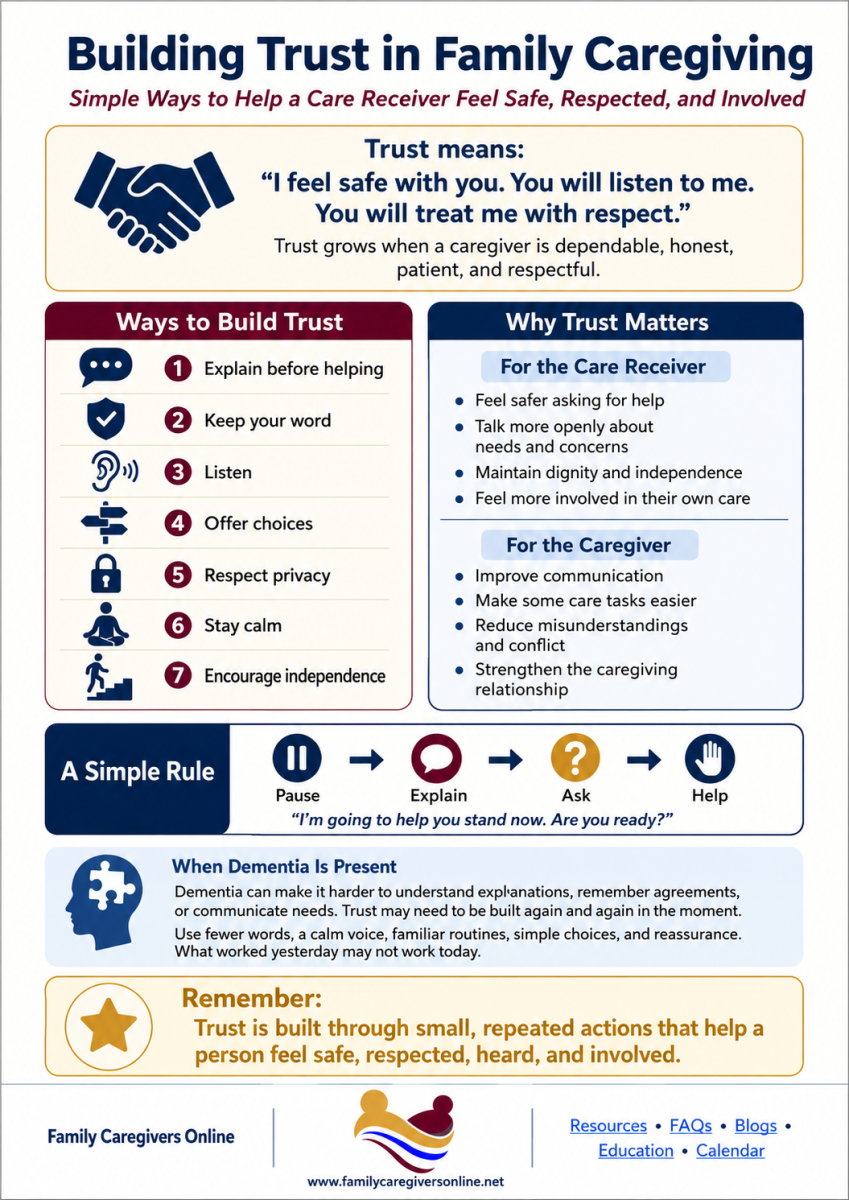
Why Trust Matters
Trust can help the care receiver:
- Feel safer asking for help
- Communicate needs and concerns
- Maintain dignity
- Stay involved in decisions
- Feel respected as a person, not just as someone who needs care
Trust can also help the caregiver:
- Improve communication
- Reduce misunderstandings
- Make some daily care tasks easier
- Better understand the care receiver’s preferences and concerns
- Protect the relationship underneath the caregiving responsibilities
Trust will not eliminate every disagreement or difficult care situation. Illness, pain, disability, fatigue, and changes in thinking can make cooperation difficult even in a loving and trusting relationship.
When Dementia Is Present
Dementia, including Alzheimer’s disease, can change how trust is expressed and maintained.
A person may not remember an explanation, recognize why help is needed, or remember that the caregiver has helped safely many times before.
In these situations, trust may need to be repeatedly rebuilt in the moment.
Try:
- Using fewer words
- Speaking slowly and calmly
- Approaching from the front
- Explaining one step at a time
- Offering one or two simple choices
- Using familiar routines
- Allowing extra time to respond
- Trying again later when possible
What worked yesterday may not work today.
The goal is not perfect cooperation. The goal is to help the person feel as safe, respected, and involved as possible.
Remember
Trust is built through small, respectful actions repeated over time.
Explain. Listen. Offer choices. Protect privacy. Keep your word. Stay calm. Encourage the person to do what they safely can.
“You still matter. Your choices matter. Your dignity matters. I am here to help.”
By Zanda Hilger, LPC, Founder, Family Caregiver & Program Manager for Family Caregivers Online
We hope this information is helpful to you in the important work you do as a family caregiver.
For more resources, subscribe to our free newsletter!



